The Great Google Sign-In Disaster: When Overengineering Nearly Killed My SaaS
A cautionary tale about why sometimes the "clever" solution is actually the wrong solution
You know that feeling when you're deep in code, riding that wave of confidence where everything seems possible? That intoxicating moment when you think, "I'll just add this one complex feature because I'm smart enough to figure it out"?
Yeah, well, I just learned why that feeling is dangerous.
What Is "Vibe Coding" Anyway?
Before I dive into my disaster story, let me explain what I mean by "vibe coding"—because this whole mess started with my love for this approach.
Vibe coding is when you're in that magical flow state where you're not just writing code, you're vibing with it. You love tackling complex challenges, throwing ambitious features at your project because you know (or think you know) you can solve them later with some tweaks and creative problem-solving.
It's that confidence-fueled coding style where you say "yes" to difficult tasks, trust your ability to figure things out, and let your intuition guide the technical decisions. Sometimes you build something way beyond your usual scope because you're riding that wave of "I can break through this barrier."
I've always been a vibe coder. It's led to some of my best breakthroughs and most creative solutions. But this time? This time it nearly broke my entire SaaS project.
The Setup: Everything Was Going So Well
Picture this: I'm building my SaaS product, and things are humming along beautifully. The landing page? Polished. The checkout flow? Seamless. Payment gateway integration? Working like a charm.
My flow was elegant (or so I thought):
User visits reebews.com
Browses pricing, picks a plan
Fills out checkout details and pays
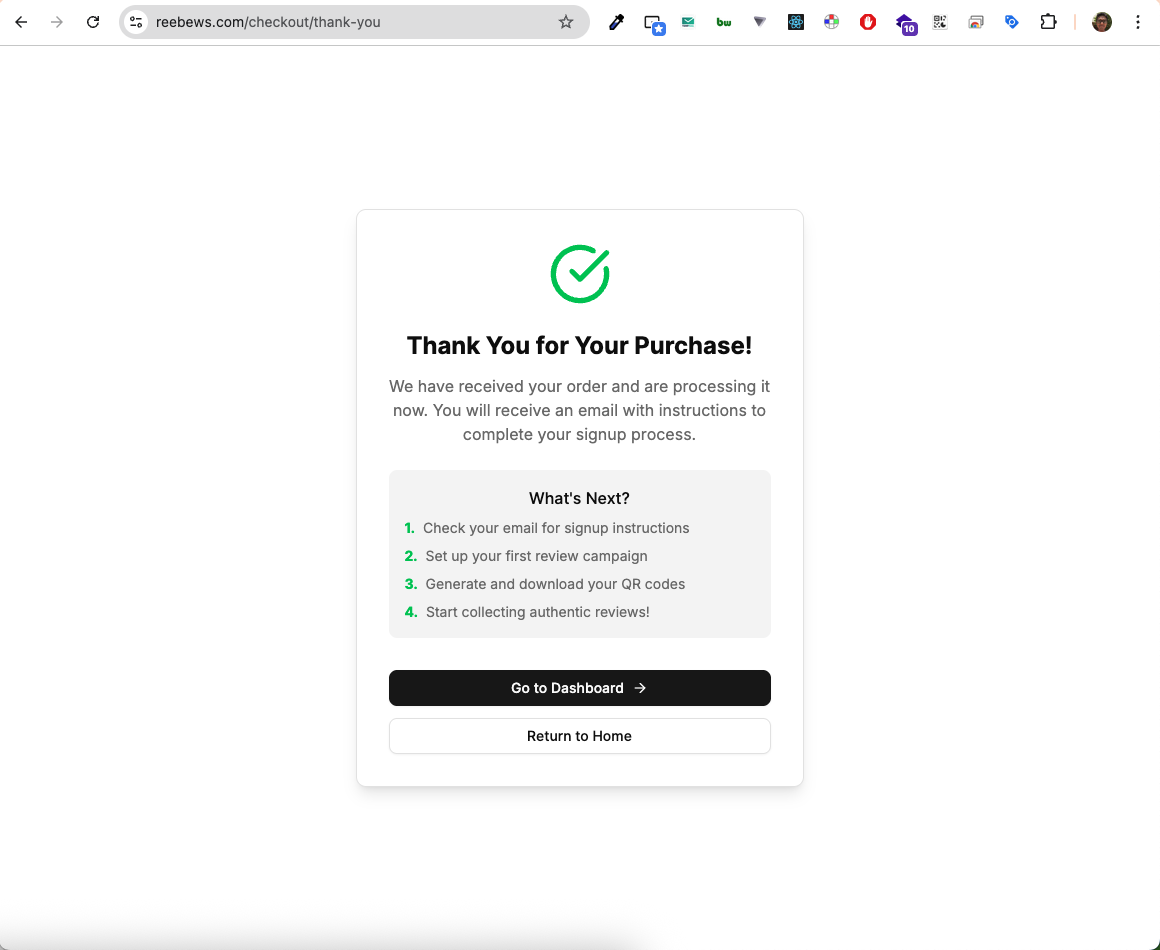
Gets redirected to a thank-you page
Receives an email with a signup link (valid for 24 hours)
Clicks the link and completes registration
Gets redirected to their shiny new dashboard
Simple, right? The traditional email/password signup worked flawlessly. Users were signing up, payments were processing, and I was feeling like a coding wizard.
But then I had that thought.
The Fatal Decision: When Vibe Coding Met Reality
"Why not give users options?" I thought. "Traditional signup AND Google sign-in for a seamless, passwordless experience. I'm basically the next Steve Jobs of SaaS!"
This was pure vibe coding in action. I saw a complex challenge—integrating two different authentication methods into my post-payment flow—and thought, "I've got this. I'll figure it out as I go."
Narrator: He did not have this.
Here's where my vibe coding confidence crashed into reality. Google sign-in has its own flow—its own rules, its own timeline, its own way of doing things. And my clever post-payment signup system? It didn't play nice with Google's ecosystem.
But true to my vibe coding nature, I didn't back down. I thought I could bend Google's authentication to my will with some creative problem-solving.
The First Red Flag: The API That Wouldn't Call
In my traditional flow, after signup completion, I'd make an API call to save user details and payment information. Clean. Predictable. Perfect.
With Google sign-in? Crickets.
The frontend looked smooth—users were signing in, getting redirected to the dashboard. But behind the scenes, my API calls were failing. The user data wasn't being saved. It was like having a beautiful storefront with no inventory in the back.
After several failed attempts, my vibe coding instincts kicked in: "Since Google takes over after 'Sign Up with Google' is clicked, why not make those API calls beforehand?"
Classic vibe coder thinking—find a creative workaround instead of questioning the entire approach.
It worked!
For about five minutes, I felt like a genius. Then I discovered the monster I had created.
The Horror: A Security Nightmare Unfolds
Here's where things got truly terrifying. A user could:
Pay with
john@gmail.comduring checkoutBut then sign up with
totallynotjohn@gmail.comAnd still get dashboard access
Even worse? Someone could skip the entire payment process, click "Login with Google" with any account, and magically access the dashboard.
I had accidentally created the world's most expensive free trial—except it wasn't a trial, it was just... free.
The Panic: When AI Couldn't Save Me
I was using Clerk for authentication (my first time, having switched from NextAuth/Auth.js due to update concerns). I threw the problem at AI:
"Fix this security vulnerability!"
The AI dutifully created a 403 Unauthorized page. Great! Problem solved!
Except now everyone was getting 403 errors—including legitimate users who had actually paid.
I was stuck in authentication hell.
The Moment of Truth: Sometimes You Need to Start Over
Desperate, I turned to ChatGPT with a simple question: "Am I overcomplicating this? What would an easier flow look like?"
The answer hit me like a cold shower:
"Yes, your flow is unnecessarily complex. Here's how successful SaaS products actually do it:"
Sign up first (traditional or Google)
Then collect details
Finally process payment
Not the other way around.
I had been doing it backwards. Every major SaaS product follows the sign-up-first pattern, and there I was, trying to reinvent the wheel with a square design.
The Painful Solution: Delete and Start Over
The hardest part wasn't admitting I was wrong—it was accepting that I had to delete weeks of work.
I had two choices:
Rebuild the entire flow from scratch
Remove Google sign-in and stick with traditional authentication
I chose option 2. It hurt, but sometimes the best code is the code you delete.
The Moment of Truth: When Vibe Coding Hits Its Limits
This disaster taught me that vibe coding—as much as I love it—has its dark side. When you're confident you can solve anything with enough creativity and persistence, you sometimes miss the obvious solution: don't create the problem in the first place.
My vibe coding mentality had me so focused on bending existing systems to my will that I never stopped to ask: "Is this the right approach?"
Here are the two invaluable lessons this taught me:
1. Study Before You Build
Always research how successful products handle similar flows. They've already solved the problems you're about to create. Their patterns exist for reasons you haven't discovered yet.
Don't try to be clever. Try to be effective.
2. Commit Like Your Life Depends On It
Version control isn't just for team projects—it's your personal time machine.
Think of commits like game checkpoints. Every time you reach a stable state where you're satisfied with your work, commit it. When (not if) you need to backtrack, you'll have a clean starting point instead of a tangled mess.
I learned this lesson the hard way, but when I finally needed to remove the Google feature, I had a clean checkpoint to return to. It saved me from starting completely over.
The Road Ahead
I'm now in the next phase of my project, building on a solid foundation instead of a house of cards. The traditional signup flow is working beautifully, and users are successfully onboarding without any authentication nightmares.
Vibe coding is still my superpower—but now I know when to channel it and when to step back and learn from others.
Sometimes the boring solution is the right solution.
The Takeaway: Channeling Your Vibe Coding Powers Wisely
Innovation is valuable. Experimentation is important. And vibe coding—that intuitive, flow-state approach to tackling complex problems—is genuinely powerful.
But there's a difference between pushing boundaries and ignoring the lessons of those who came before you.
Next time you're in that vibe coding zone and think "I'll just add this complex feature because I can figure it out," pause and ask yourself: "How do successful products solve this problem?"
The answer might save you weeks of headaches, one very humbling blog post, and the painful experience of deleting perfectly good code.
What's the most painful lesson you've learned while coding? Share your disasters—I promise mine was probably worse. Follow me for more tales from the trenches of SaaS development.
Join the conversation
Sign in with Google or GitHub to share your thoughts
Loading comments...